
How to Use Social Media to Market Your Book
Authors rely on relationships to create sales. When your protagonist or personal story connects with a reader, you’ve taken the first step toward building a connection.
Although a first step is necessary, many authors fail because they stop trying or don’t know how to embrace the next part of their journey.
When someone can meet or interact with you to discuss your work, casual readers turn into repetitive customers. If you can build a community large enough to look forward to your next title, income security becomes possible.
Don’t get us wrong: traditional outreach efforts still work, such as book signings and story advertising. However, when you want to take your marketing to the next level, it’s time to get social!
Why Should You Be on Social Media Right Now?

Writers transform ideas into stories and usable information. The processes behind social media marketing work for fiction and non-fiction works alike.
Although how you’d communicate to people is different in fiction vs. non-fiction marketing, your goal is to interact with your audience.
You set goals as a writer to become an author. Once you’ve accomplished that outcome, it is time to apply the same approach to your social media marketing needs.
These tips can help you find the best marketing platform, start interacting with others, and establish your reputation as an author.
1. Double Down on Your Reasoning
Even if you’re James Patterson and have 325 million copies sold to your credit, your audience isn’t “everyone.” You wrote a book to reach a specific demographic. As you get active with your social media marketing, it is time to find that target audience.
If you’re an independent author, the first step is to establish a profile. You should follow people that genuinely interest you. As you start interacting with others, your efforts will grow organically – and sometimes rapidly!
Facebook and Twitter are the prominent platforms, but you can find authors successfully marketing themselves on Instagram, Pinterest, Tumblr, and others.
2. Find Your Writer’s Voice
Your social media writing voice should be comparable to what readers experience in your book. If your posts and conversations lack enthusiasm or authenticity, your marketing efforts are less likely to succeed.
How you interact with your audience is also essential. If you’re writing teen fiction, your tweets about The Dick Van Dyke Show won’t resonate well. When you have Baby Boomers as your primary audience, you could probably start a passionate discussion about Bob Newhart that generates some sales.
Finding your voice requires you to be consistent and to know what your readers want.
3. Creates Posts Based on a Structured Calendar
It helps to create a social media marketing calendar for your outreach efforts. Each item you send to your audience should have strategic value to it. That doesn’t mean you cannot add something brilliant immediately that pops into your head, but your approach shouldn’t be 100% improv.
Here’s a sample schedule to consider.
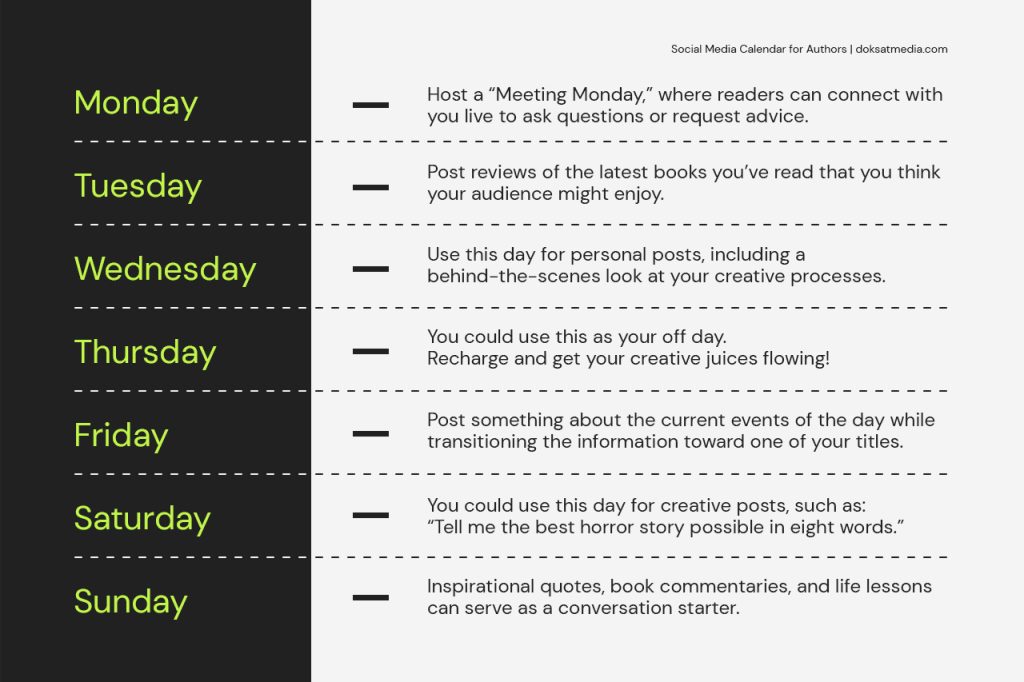
When you keep your social media marketing efforts on a routine calendar, it is much easier to avoid the perils of writer’s block.
4. Put the “Social” in Social Media
If you take the time to connect with readers and leave comments on their posts, your actions can make their day. It might only take a few seconds, but your efforts show that their input mattered to you.
It helps to reserve about 15-30 minutes each day to read and comment on social media. If you don’t have many posts to review, it’s okay to cut that time a little short.
Don’t forget about looking on other pages to leave comments on other posts!
5. Respond to Honest Criticism
It won’t take long for your social media marketing efforts to encounter negative criticism. This feedback comes in several forms: trolls, boredom, and cyberbullying are a few ways that your books might not get the attention you want.
The best way to resist an escalation in this unwarranted behavior is silence. If you don’t interact with these individuals, they’ll typically leave you alone.
When someone offers honest feedback, even if it feels like negative criticism, a genuine response can boost your social marketing visibility. Your efforts show that you’re willing to listen, solve problems, or accept diverse opinions.
6. Share Content and Shareable Posts
When you post content online, you’re creating something that others can share. Why not use the same approach when you see something interesting?
One of the best reasons to market on social medial is that your posts don’t always need to be 100% original. If you share, pin, or retweet content for your readers to enjoy, the outcome functions as well as a personalized post.
The content you share depends on the reaction you want to receive. You could pursue one of the top 12 types of content to create for social media, homemade reaction videos, or online tutoring lessons to help others become better writers.
If you think the content from others has value, share it.
7. Track Your Mentions
Although online content generates lots of metrics, you never understand how many people are talking about your book with that data. As an author, you need to know when others say your name or mention your work.
Instead of hanging around your computer or phone all day for notifications, invest in a tool like Mention.
You can find competitive, market, and audience insights with this one tool. Mention monitors the web across one billion sources, including blogs and forums, to see what people say. By reviewing these posts, you can better understand how to refine your social media presence.
Mention comes with a 14-day trial to see if it would be useful for your social media marketing efforts as an author.
8. Expand Your Platforms
It helps to start on a single social media platform to avoid feeling overwhelmed by the process and work. Once you get comfortable with these interactions, it is time to think about expanding your efforts.
If you chose Facebook first, you might try adding Twitter to your daily routine.
The one mistake that many authors make is to post the same content on every platform. That work dilutes your message instead of expanding it!
When you expand your platforms, it helps to think of each one as an independent community. Their thoughts, needs, and requests will be different. If you can keep making the relationship connections, your work will eventually start diversifying your audience.
9. Embrace the Hashtags
You don’t need to hashtag everything to get search results. Even when you do use them, the purpose must be strategic.
The optimal hashtag number for an Instagram post is 11. When you’re on this platform, each update generates a 12% engagement increase.
When you start using them, here are a few things to remember.
- Use specific hashtags instead of generic words. People don’t need to know that you’re #happy, but they do want to be part of the #LocalAuthorClub commentary.
- The hashtags should have relevance to your readers. That’s why you might use the #SeattleWritersConference as part of your post, but not #GettingCoffee.
- Your efforts should reflect your brand’s goals. If you’re using the same hashtags as everyone else, your information gets lost in a sea of white noise.
Once you start using your hashtags, you can see from each platform’s analytics how well your posts are performing. This data helps you refine each post, interact more consistently, and possibly develop the next pitch for another book.
Are You Ready to Start Making New Connections?
As you slip into a daily routine that includes social media marketing, you’ll notice some benefits start happening as the days pass.
- Your readers have more awareness about who you are and what you write.
- There could be higher levels of inbound traffic to your website.
- Your search engine rankings might start improving.
- You can see your sales figures begin rising.
You could pay thousands to purchase traditional advertising methods without gaining the insights that social media marketing offers for free!
If you’re ready to have people start reading your book, it is time to get your social media marketing efforts off the ground. When you follow the ideas outlined in this content, you’ll be taking the next step in your author’s journey.